Wednesday, August 22, 2007

More Signs of Summer

Summer day at Stone Steps Beach, LeucadiaI can't help it. The beach has been the needed oasis of cool. Water temperatures have reached bath tub levels—the high side of 75—allowing me to stay waterside for a good hour. Wave after wave—when the shoulder right (or left) is there, you take it.Water temperature exceeded 75 degrees--we embraced the tepid waterSerenity.Follow the footsteps to surfer heavenFollow the footsteps in the sand.Three fishermen are one with the sea, so sayeth the sea gullThe fishermen, the sea gulls, the surfers, the swimmers. We all share the glories of the seashore.

Monday, August 20, 2007

Signs of Summer

Mimosa: summertime brunch drink at Shades in Ocean BeachMimosa, a summertime drink
Shades of summerShades of summer
Bike power at the beach with a shimmering simmering backdropBike power at the beach
The OB PierThe OB Pier
Sticks on paradeSticks on parade

Wednesday, August 15, 2007

Luscious Tomatoes

Harvested tomatoes, zucchini, and cucumberand other veggies too. While I certainly try, I cannot possibly eat all of these tomatoes. Even after multiple pasta sauces, roasted vegetable ratatouille, minestrone soup, fresh tomato and cucumber salad, and fresh tomato slices on ... everything. I am thinking of a roasted tomato garlic purée ...


Recipe: Roasted Tomato Garlic Soup
1 head garlic, cloves separated and peeled

8 (approx.) medium tomatoes, preferably home grown

5 cups water or stock, divided

1 Ω teaspoon dried thyme leaves

1 teaspoon freshly ground black pepper

1 teaspoon coarse sea salt

4 tablespoons olive oil, divided

4 medium onions, thinly sliced

2 tablespoons chopped fresh Italian parsley, for garnish


  1. Preheat oven to 350 degrees F.

  2. Quarter the tomatoes and place them in a shallow roasting pan. Add the peeled garlic cloves. Drizzle with approximately 1 tablespoon olive oil. Add 3 cups of the water/stock. Sprinkle with the thyme, pepper, and salt.

  3. Cover the pan with aluminum foil and bake for 60 minutes, stirring once during the baking.

  4. Remove the foil, stir again, and bake for another 30 minutes.

  5. While the tomatoes and garlic are baking, heat 3 tablespoons olive oil in a soup pot. Add the sliced onions, cover and cook over medium heat until tender and lightly colored, about 15 minutes.

  6. Add the remaining 2 cups of water/stock to the onions and bring to a boil. Reduce the heat, cover, and simmer for about 30 minutes.

  7. When the tomatoes and garlic have finished baking, transfer them to the soup pot. Using a stick blender, purÈe the soup until smooth.

  8. Adjust the seasonings, ladle into soup bowls and sprinkle each bowl with fresh parsley.

6-8 servings.

Sunday, August 12, 2007

Being a Part of History at the Ballpark

“Hi, I just landed.” —me, from the airplane, landing at Lindberg Field, San Diego.

“Oh, man! It’s extra innings . . . did you hear what happened?” —Paul, from PetCo Park, Saturday night, August 4, Padres vs. the Giants.

“No, what’s up?” —curious, I’ve been ensconced in an airplane for the past four hours—I have no idea what’s going on.

“Bonds tied the record in the second inning. We are all here—Kellen, the two Kyles and I.” Father-son fantasy realized. Be at the ballpark when Bonds ties the record. Not a Giants fan. Not a Barry Bonds fan. But baseball history is baseball history. In person. They are there.

“Okay, call you later.” . . . thinking . . . He really does not want to leave the game early just to pick me up at the airport. Extra innings. No problem. I’ll get a cab. Pull out cell phone. Redial.

“What’s up?” he asks. It’s still extra innings.

“Hey. It’s me again. Look, I’ll get a cab to the Omni. Meet you at the bar.” I’ve just flown in from Canada, but you’re at the ballgame with our son and the boys. I can chill.

“Yeah! Great idea!” —obviously relieved— “Call me when you get here.” You’ve just flown in from Canada and I’m at the ballgame with our son and the boys. You can chill.

So I share a cab with a charming young woman who lives a few blocks from PetCo Park downtown San Diego. The Padres game has just ended when I arrive at the Omni (which connects to the ball field). The Padres win. Yeah. Here’s to you Barry, but the Padres won. Now you can go home and break the record in San Francisco. The Padres beautiful ball park is on the cover of SI just because Barry hits a home run. The game ran so late that the L.A. Times ran the story about Barry tying the record but did not record the winner of the game. So just in case anybody out there in baseball land doesn’t know: Barry hit his record-tying homerun against the Padres, but the Giants do not win. The Padres beat the Giants.

In fact, a mere three days later, Barry breaks the record in the Giants versus Washington Nationals game. The Giants do not win. The Nationals win the game.

But we aren’t going to remember all that. We’ll remember the father and the son who were able to witness baseball history live, in person, together. How cool is that?

Friday, August 10, 2007

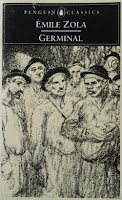
Émile Zola's Germinal

Emile Zola's GerminalI selected Émile Zola’s Germinal for Book Club in June. I originally read the novel about 10 years ago and reread it for Book Club. By rereading it I’ve come to appreciate Zola’s work even more.

When I first read Germinal, I came away with the idea that Zola wanted to address issues of economic classes, labor and society, and basic needs of working class people, such as health care and living wages. Sandwiched into these societal issues were more personal challenges such as love, loyalty, honesty, industry and the literary workings of a tragic character. Zola uses irony and he juxtaposes bourgeois families with poverty-stricken families.

The second time I read Germinal I still appreciated the tragic, uphill struggles of the miners and the individual characters that played a part in this epic story. But what was new to me was the feeling that Zola didn’t so much write a novel as he created a series of paintings that beg us to visualize his settings. We enter the museum (okay, I am visualizing now) and in the first room we see a beautiful but haunting painting of the early-spring landscape (April, or the germinal month), treeless with ugly slagheaps, smoke that curls into the grey sky, and grey figures that are but shadows trudging their way to the mine. It is a beautifully-wrought but haunting landscape.

The next painting perhaps shows old Bonnemort and his horse down in the pit. Over and over Zola portrays the mine as a living monster that devours the workers. We see the haphazard timbering, the hay, the wet walls, and the lamps that provide the only light. There is a sadness to Bonnemort’s face and we detect a bond between the man and the horse. The horse and the man are both slaves within the working mine. They bond because they suffer together.

Another painting shows several miners at work. Their shirts are off and their bodies are glistening with sweat. The air outside is cold, but in this living hell, temperatures rise dramatically. Their arms and shoulders which have worked in the mines for all their lives should be strong and steady. Instead, they seem weak and exhausted.

Still walking through the museum, we see an oil painting that depicts the Maheu’s family room. It’s early morning and Catherine is fixing coffee and building up the fire. Again, it is dark and the oil lamps and the fireplace provide the only lighting. She is careworn but young, a sad figure. Yet, there is somehow hope in her eyes. Hope that she can do better than her parents. Hope that she can find a way to create a comfortable living situation for herself. Hope that she can rise above the rabble.

The labor/union meeting in the woods is carefully composed. This painting is not quite a landscape, but larger than the intimate paintings we have seen of the miners. We see the group, with Étienne, Maheu, Rasseneur all prominently positioned with others eagerly looking on. The peasant dress, the lively discussions, and the fallen branches used as makeshift sitting places all help portray the intensity of the meeting.

I can imagine many more paintings. The pub, the company town of Montsou, and the mob scenes (there are several—Zola seems to excel at describing incredibly realistic and frightening mob scenes) all are adaptable to a visual representation.

I heartily recommend this novel.

And how relevant is a 19th century novel about working in a coal mine, dealing with fair pay and disasters where loved ones are trapped, maimed, or sick from breathing coal dust their whole lives? Surprisingly relevant.

March, 19, 2007: Siberian mine blast kills most in 10 years
“Labor union officials blamed the explosion in part on quota systems that encourage miners to work faster and dig more coal, potentially leading to errors. Some government officials in the past have accused private companies of cutting corners on safety measures in order to save money.” (Source)
May 24, 2007: 38 killed in blast at Russian coal mine

And of course, a bit closer to home:

August 6, 2007: 6 trapped in Utah coal mine collapse

Lastly, Germinal is one novel in a 20-volume series depicting several families in 19th century France. Zola’s output is staggering, considering the depth of his characters, descriptions, and actions portrayed in his work.

Monday, August 06, 2007

Family Reunion at Weslemkoon Lake

Canoeing at sunset on Weslemkoon Lake, Ontario, CanadaSomewhere between Toronto and Ottawa in beautiful Ontario “cottage country” lies Weslemkoon Lake. My cousin Patti and husband Chris’ family has owned a cottage there for 40 years. Over a year ago Patti organized a family reunion for her siblings, cousins (first, second, once-removed, twice-removed and any combination thereof), nieces and nephews, and aunts and uncles. Over 25 people attended. Beds were provided for all who were over 50; tents and sleeping bags were arranged for the youngsters. Weslemkoon Lake proved a wonderful spot for the week-long affair. With skiing, tubing, swimming, sailing, sail boarding, canoeing, kayaking, and hiking, no one was bored and everyone who wanted to got their fill of exercise and fun.
Also, there is no road access to the cottage; it's a 10-minute boat ride from the marina. It is also out of cell-phone range, there is one land line, and no television. This is heaven!

View of Weslemkoon Lake from the cottage porchDinner for 26? No problem. Enough people pitched in to chop, sauté, grill, whip up, and griddle that no one went hungry. Clean up? Group participation ensured that all dishes were cleaned and the work load was spread about.
Handy aluminum boat for putting around Weslemkoon Lake, Ontario, CanadaBut all this was possible due to the incredible organization skills of our hosts Chris and Patti.
Sitting on the dock, watching the sun set at Weslemkoon Lake, Ontario, CanadaAnd while the setting was wonderful, the true wonder was visiting with cousins I haven’t seen in years and meeting cousins for the first time. From a six-year old first cousin once-removed cutie-pie to my aunt and uncle 80-years young, we shared a few days packed full of action, peppered with conversations long overdue.

Wednesday, July 25, 2007

Anza-Borrego Pull

Silver Cholla Cactus in Anza-Borrego DesertAnd thank you all for dropping by today. Let’s give the band a hand . . . yes, yes—aren’t they wonderful! I hope you are enjoying the food; I spent hours picking out today’s menu. My friends all said “You better choose something with a bit of ham. People always like a little ham.” Okay, okay.

Today is my one year blogiversary. So I am celebrating. (Here is my first post.)

Yeah, yeah. Thanks so much. And as such, I’d like to say a few words about the glowing silver cholla cactus that sits atop my blog header (a larger version of the same photo appears above).Ocotillo and BrittlebushBack in March of 2005 when the California deserts were experiencing a centennial rainfall year, the desert wildflowers bloomed like never before. I saw whole valleys covered with yellow Desert Sunflowers, purple Sand Verbena and white Dune Primrose. The Ocotillo produce gorgeous red blooms that fly like flags against the blue sky. Jimson weed grows white trumpet-like flowers and cacti of all kinds sprout colorful flowers that emerge from the cactus spikes.
Ocotillo Cactus I love the Anza-Borrego desert. It glows in its own starkness. It’s big and clean. I have never seen more stars than the night I slept outside in the desert. It was August and it didn’t cool down until about 3:00 in the morning. Since I couldn’t sleep anyway, I just looked up. No moon. But the sky was littered with diamonds and the Milky Way arced across the heavens.
Jimson Weed The next day my friends wanted to go hiking (they were obviously delirious from lack of sleep), but I talked them into retreating to the cool mountains for breakfast instead. Day time temperatures would sore to over 110 degrees F and ground temperatures can reach 140. I didn’t think we could carry enough water. I didn't think it was safe.
Beavertail CactusThe only time to see wild flowers in the desert (there are none in August) is in spring, which can start as early as February. Things are pretty much gone by the end of April, but it always depends on the winter’s rainfall.

Monday, July 23, 2007

The Stories of Eva Luna

My dog-eared copy of The Stories of Eva LunaWith The Stories of Eva Luna, Isabel Allende creates a treasure trove of stories, delicious treats of woven fantasy that explore how people cope with, use, and abuse power. As Allende shows us, power can manifest itself in many ways: in many of the stories she gives us the power of love—how it can bring redemption or destruction. Allende draws for us many powerful women (and men)—people who persevere and tackle poverty, injustice, and brutality. In just a few pages, Allende paints a picture that enthralls you and pulls you into a world that is magical and ethereal.

“Two Words” tells the story of a poor, illiterate girl who learns to read and write with an inborn talent. She makes a living selling words, stories, and letters. She ends up taming the most powerful and feared man in her country with the power of her words and her beguiling spirit.

“Toad’s Mouth” brings us a powerful woman, who mesmerizes and enchants countless men through sexual prowess and who, in turn, is tamed by a mysterious foreigner in a hilarious, bawdy adventure of life in a wild and desolate country.

In one of my favorite stories, “The Little Heidelberg” gives us El Capitán, a Finnish sea captain who has retired in an unnamed Caribbean port and dances weekly with a lovely Russian woman, Eloísa; she smells of chocolate from so many years of making bonbons. While language keeps their communication at bay for forty years, his reticence for speaking is broken when a countryman is able to translate his words for the first time. “Will you marry me?” he asks his long time dance partner and she says “Don’t you think this is a little sudden?” As they dance the celebratory acceptance dance, with each twirl she becomes a bit younger. In the magic of the scene, she twirls out of existence. Her disappearance seems to reflect the dreamscape nature of the scene. Perhaps El Capitán simply imagined asking her and when the music stops, she is no longer there because she had entered his dreams years earlier. We don’t know if her disappearance is her lesson to not wait so long to reveal our true feelings or a magical journey that is unexplained.

Revenge and justice are topics that Allende also explores. In “Revenge” a woman dedicates her whole life to avenging her father’s death. Upon the moment of truth when she must cut down the man she has hunted her whole life, she cannot. Love takes away her ability to carry out revenge. This leaves her unwhole. Her only solution is to take her own life. And the man? He suffers fate worse than the revenge that was long planned for. “. . . he knew he would live to be ninety and pay for his guilt with the memory of the only woman who had ever touched his heart.”

The final story “And of Clay We are Created” is perhaps my favorite for its poignancy and mysticism. It elegantly details the transformation of two people, as well the narrator who vicariously injects herself into the story, in a mingling of spiritual comfort, facing the past, and accepting the present.

This book is one to read, savor, and reread. You will forget the details of a story, and as you go back to reread it, new details will emerge that make the story sweeter, more ironic, and more satisfying.

Thursday, July 12, 2007

A Bit About Lady Bird

Lady Bird Johnson died yesterday at her home in Austin, Texas. There was a lengthy article about her in today’s Los Angeles Times describing her role as first lady and some of her accomplishments. Among other achievements, she is credited with paving the way (sweet irony) for the environmental movement of the 1970’s.

Of course, President Lyndon Johnson’s role in the Vietnam War tarnished his laudable part in promoting civil rights. According to the Times article, one of the reasons he declined to run for a second term in 1968 was the civil unrest associated with the Vietnam War. This decision was preceded by a visit from his (pregnant) daughter Lynda, whose Marine husband was about to be deployed to Vietnam. She appealed to her father “Why do we have to go to Vietnam?” That night Johnson announced he would not run again for President and also halted bombing of North Vietnam. You see, it does matter when those who propagate war have something to lose. If our current president, also with two daughters, had a like investment in the war of his own family’s welfare, would different decisions be made?

There were several points that came out of the article that amazed me, two in the same paragraph, which I quote here.
The young congressman [Lyndon Johnson] lost a Senate bid in 1941. Later that year, after the Japanese attack on Pearl Harbor sent the country into World War II, he fulfilled a campaign pledge by joining the Navy. He put Lady Bird in charge of his congressional office, which she managed efficiently. She overcame her shyness to lobby Cabinet members and other Washington officials on behalf of constituents.
Wouldn’t it be nice of all congressmen and women would promise and then keep their promise to enlist in the armed forces if our country goes to war? But, you say, if every congress person did that, we’d have no congress? Ya think? It might have made for a different vote back in 2002 giving the president such quick and unchecked permission to use force against Iraq.

The second point was that she lobbied Cabinet members on behalf of her constituents. Whoa. What a novel idea. When’s the last time your congress person (or spouse of congress person) lobbied the White House on your behalf?

Update: I contributed this same post at BlogHer.org here, which includes a few comments.

Tuesday, July 10, 2007

Summertime Greenery

Chives and Sweet Basil growing in my summer gardenSummer time is fun for gardeners. Above you see chives (wonderful for garnishing soups and of course they are great with baked potatoes) and sweet basil (I'm a big pesto fan). Here in Southern California we can grow vegetables and herbs year-round, but summer is when we grow the good stuff: tomatoes, basil, beans, peas, zucchini, and cucumber. I use the Square-Foot Gardening technique by Mel Bartholomew (or the updated one is here). There are differences in the books; some reviewers recommend them both for the most complete reference.
Raised garden box with zucchini and cucumbers (on the left)
Here's the big picture: you build raised garden boxes (I made mine four feet by six feet out of two-by-twelve redwood boards and lined on the bottom with chicken wire to keep out root-loving gophers). You import nutrient-rich soil and divide the boxes into one-foot squares. How many plants per square depends on the vegetable. Lettuce, basil, chives all are four plants per square. Tomato is one per square. Zucchini requires nine squares (a three-by-three portion of your garden box, as shown above).
Chive flowerChive bud
Chives have beautiful flowers and buds that give your garden a bit of color.
Still-ripening tomatoesPole Beans
These tomatoes are getting there. And, here are my pole beans, just beginning their climb to the sky.

Monday, July 02, 2007

Four Corners of Europe

Geo Map Overlay from Google AnalyticsI have to admit that I’m addicted to Google Analytics. No, I don’t check my blog’s stats everyday, but I’ll check the reports every week or so (okay, sometimes every couple of days).

One of the most fascinating reports is the Map Overlay, graphically depicting the sources of your visitors using a dynamic world map. You can zoom in to a particular continent, subcontinent, or country. At any level you can view the city-level source, getting size- and color-coded dots representing the number of visitors. (The real report displays the city name and number of visitors when you hold the cursor over the dot. Here you just see a static screen shot, so you won't get the same dynamic behavior.) Of course, some of these visitors are what I call “accidental” visitors, where the search term they used pinged your site, but it was a false match. It happens. Nevertheless, for the month of June, the four extreme compass points within Europe that visited my site are
North: Rovaniemi* (capital of Lapland, Finland)
South: Athens (Greece)
East: St. Petersburg (Russia)
West: Lisbon (Portugal)
The European city that contributed the most visitors is London. Once you sign up, Google Analytics site provides customized Javascript code you embed in each page you want to track (put it in your blog template and it will show up on each page). You can also add custom code to track when a user clicks a link to go to an external page or to download an mp3 file (for example). And, you can put in a filter to exclude your own clicks from the data collecting. The Analytics site tells you how to do all this and (in my experience) the technical support is good about answering questions.

*Rovaniemi is way up north near the Artic Circle. You can see the midnight sun from June 6 through July 7. What a great way to get a bit of geography knowledge.

Friday, June 29, 2007

Sugar Coating and All

Coating of sand is required for beach playI have to tell you about this kid I saw at the beach the other day. It was one of those perfect summer days—warm, windless, with lazy, rolling surf that cools the skin. Beaches are perfect playgrounds for kids and pockets of children were building sandcastles and chasing each other around in the shallow water.

On this particular afternoon, I was mesmerized by a boy splashing in the sudsy water. He emerges from the soup and with spindly legs exuberantly tromps towards the soft sand; arms flail and water drips. The child scarecrow drops to his knees to pay homage to the warmth and softness that beckons. He flops onto his stomach and chest and dabs his face into the granular pillow. Like a cook carefully breading a chicken breast, he sits up, turns over, and lies back down to coat his backside. A child can lie still for only so long, and soon our sand-child sits up again and proceeds to anoint his head with sand, sprinkling his hair with the beach’s fine-grained sugar.

Most people pull back with disgust and think twice about all that gritty sand invading places where the sun don’t shine. But I see this child, so free and unencumbered. Fully sugarized, the boy jumps up and sprints to the water. He’s obviously delighted with the beach’s contrast of water and sand and begins the dipping and coating process anew.

Monday, June 25, 2007

BREWfest: Music on the USS Midway

Last week’s BREW 2007 Conference was a chance for Paul to give his presentation (Developing C++ Class Libraries with BREW) on Friday to a full house. The conference itself was sponsored by Qualcomm at the Manchester Grand Hyatt in downtown San Diego on the harbor.

As one of only two C++ with BREW presentations, Paul received a good response after his talk. He was in his element, sharing his techniques for using C++ effectively with BREW.

A view of the hull as we board the USS MidwayThe other C++ talk at the BREW Conference was presented by Ted Witkamp from Riffware, an up and coming cell phone product company. Check out Riffware’s new Guitar Tuner product. This cell phone program lets you tune a guitar or musical instrument with your cell phone. That gets my vote for a very cool cell phone application. (Paul will use it to tune his bass and guitar, too.)
Fighter aircraft on display on the flight deck of the USS MidwayThursday evening was BREWfest, the after-hours party sponsored by Qualcomm. This year it was held aboard the USS Midway Aircraft Carrier. I loved the setting. Being aboard the aircraft carrier provided gorgeous views of San Diego harbor and its downtown skyline.
Johnny Rzeznik of the Goo Goo Dolls stylin' on the USS Midway Besides good food and drinks, attendees were treated to a concert by the Goo Goo Dolls on the flight deck of the Midway. Not being a Goo Goo Dolls aficionado, I must say I nevertheless did recognize some of their songs. Lead vocalist, songwriter, and guitarist Johnny Rzeznik is an energetic performer. Pretty awesome for a forty-something guy!!

Thursday, June 21, 2007

Kellen the Engineer


My father (who was named Graham after his father, who in turn was named Graham after his father, who is the Graham of a previous post) graduated from Georgia Tech and was a helluva ‘n engineer—an aeronautical engineer. He designed airplanes and studied things like stability and control. This was a big departure from the previous Grahams, who were both missionaries and ministers associated with the Northern Presbyterian Church (the Presbyterian Church split over issues of slavery in the 19th century). Graham, my father the engineer, had three sons and five grandsons, none of which were named Graham, but two of the grandsons carry Graham as a middle name, as does one of the sons. And of all those progeny, one of them went into the field of Mechanical and Aerospace Engineering, which is about as close as you get to my father’s field of study. So it is with particular pride that I watched my son, whose middle name is Graham, participate in the Henry Samueli School of Engineering commencement ceremonies at UCLA. Way to go, Kellen!

Tuesday, June 19, 2007

Air Temp: Perfect; Water Temp: Trunkable

Air Temp: Perfect; Water Temp: TrunkableJune Gloom has given way to early summer sun. The Surf Conditions sign at Stone Steps says it all.
Air Temp: Perfect; Water Temp: Trunkable
This translates to 75 degrees F and 68 degrees F, respectively.
Beach Day AccutermentsThe beach day accuterments: chair, towel, fins, body board, and book bag containing this month's Book Club Selection: Isabel Allende's Stories of Eva Luna.
June Beach Day